Compounding Returns through Quality and Value
Recent market volatility highlights the uncertainty investors continue to face in 2026 amid ongoing geopolitical tensions and rapid technological change. Yet periods like these also reinforce an enduring principle of successful long-term investing: maintaining a disciplined focus on quality companies and valuations grounded in fundamentals, rather than reacting to short-term market noise.
While the backdrop continues to evolve, this philosophy has proven adaptable and robust.
It has enabled AFIC to consistently distribute fully franked dividends, with long-time investors who choose to reinvest dividends reaping the greatest benefits. Someone who invested $10,000 in AFIC in March 2001, 25 years ago, was able to take full advantage of franking credits and reinvested the dividends would have seen their investment grow 10.1% p.a. to $111,500 by March 2026.
AFIC Total Share Price Return: Growth of $10,000 invested 25 years ago*
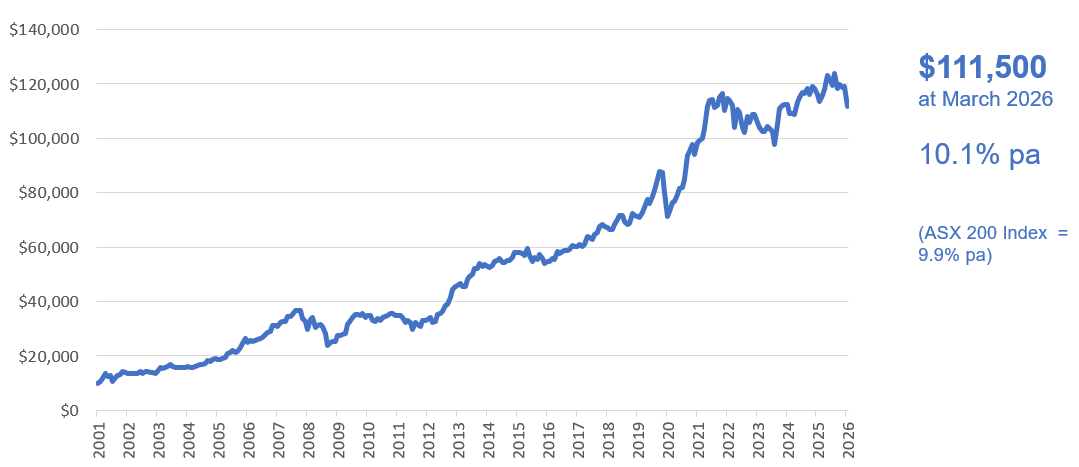
*AFIC and ASX 200 Index Total Return include franking credits. Assumes investors can take full advantage of franking credits and the re-investment of dividends.
While periods of market volatility are inevitable, AFIC has maintained its strong track record due to this unwavering focus on its core strategy and a structure that supports a long-term investment philosophy.
There are two key pillars of the strategy which have helped to generate consistent returns for AFIC shareholders over the last quarter of a century:
1. Investing in quality companies
In today’s environment, characterised by heightened volatility and rapidly shifting sentiment, the importance of quality remains as relevant as ever. Investing in high-quality companies, backing them over the long term, and benefiting from the compound returns they deliver remains one of the most proven and enduring investment strategies. As AFIC approaches its 98th year, this focus continues to underpin its approach to portfolio construction.
Quality is not defined by a single metric, but by a considered assessment of the factors that enable a business to deliver sustainable returns across market cycles. Central to this assessment is a strong emphasis on management capability.
As an institutional investor with strategic shareholdings in some of Australia’s largest listed companies, AFIC’s investment process includes meetings and discussions with senior management teams across key sectors in the domestic economy. Regular engagement with CEOs, CFOs and board chairs provides valuable insight into leadership capability, strategic direction, capital allocation discipline, and competitive advantage – factors that are critical to long-term business performance.
Quality companies with a strong foundation are better placed to navigate uncertainty – whether from macroeconomic pressures, regulatory change or evolving industry dynamics. Importantly, they are also more likely to continue compounding value for shareholders, reinforcing the benefits of a patient, long-term investment approach.
2. Maintaining a considered view to buy at value
AFIC’s history demonstrates the importance of valuation discipline. Across periods of significant disruption – including the Global Financial Crisis, the COVID-19 pandemic, and the current geopolitical tensions in the Middle East – AFIC has continued to withstand challenging market conditions.
This resilience has not been achieved by reacting to short-term market movements, but by remaining grounded in core investment principles.
In periods of heightened volatility, there is often a strong temptation to follow market momentum or become influenced by prevailing narratives. Our experience shows that the more enduring approach is to step back, assess the intrinsic value of a company and consider its prospects within a broader, long-term context. Even the strongest companies can deliver suboptimal outcomes if acquired at excessive prices.
It is this steady approach – ignoring the noise and remaining anchored to a proven framework – that has supported the construction of a robust and resilient portfolio across nearly a century.
Recent market dynamics provide a useful example. For online classified businesses, such as CAR Group and REA Group, concerns around the emergence of artificial intelligence (AI) has weighed on valuations in recent times. Yet at their core, these remain well-managed businesses with strong market positions. Our view is that these businesses have an opportunity to engage AI to reinforce their long-term value proposition, and short-term valuation pressures provide an opportunity to invest in these businesses at attractive levels for long-term investors
At the same time, valuation discipline requires restraint as well as conviction. AFIC maintains holdings in Australia’s major banks – Commonwealth Bank, Westpac, NAB and ANZ – which are widely recognised for their quality, scale and resilience.
However, parts of this sector are trading at elevated valuations. In these instances, maintaining discipline means carefully weighing the strength of the business against the price being paid, rather than simply following market momentum.
Successful investing is rarely driven by short-term reactions. Instead, it comes from maintaining discipline, staying focused on the underlying value, and applying a consistent framework through changing market conditions.